As a CNC machine tending system supplier who’s spent the last 12 years talking to shops that’ve lost thousands in scrapped parts, broken tools, and unplanned downtime from dropped workpieces or unsteady robot integration, I’ve learned that impact resistance isn’t a “nice-to-have” add-on—it’s the backbone of a tending system that actually pays for itself. When a system fails because of impact, it doesn’t just pause production; it erodes trust between operators, maintenance teams, and management. Over the years, I’ve helped dozens of manufacturers fix systems that were initially pitched as “high-speed” but collapsed after 6 months because they cut corners on impact-resistant design, so let’s break down what actually makes a CNC machine tending system impact-resistant, not just marketed as such. CNC Machine Tending System
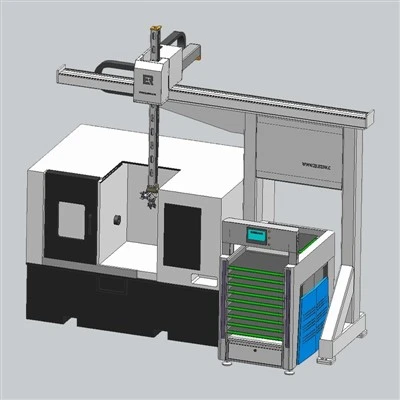
First, let’s define what impact even means in this context, because it’s not just a dropped steel workpiece. For CNC tending, impacts fall into three key categories: collision impacts (between the robot arm, end-of-arm tooling (EOAT), and the CNC machine or fixtures), load impacts (when a 500-pound forged part is set too hard into a CNC vise or pallet, or slips during transfer), and environmental impacts (like shop floor vibration from nearby lathes or press brakes that shake the system’s calibration over time). A lot of suppliers will brag about “impact testing to 10G” but fail to specify that that testing is for tiny, light plastic parts—not the 400-pound aluminum billet you’re running in your milling center. Real impact resistance is tailored to the specific demands of your workload, not a generic lab test.
Let’s start with collision impact resistance, because that’s the most common (and costly) failure point. I’ve seen systems where a supplier used a standard 6-axis industrial robot without custom collision sensing, and when an operator loaded a part slightly off-center, the robot’s arm jammed into the CNC’s work envelope hard enough to crack the machine’s steel table and bend the robot’s wrist. A good tending system doesn’t just have collision detection—it has integrated, machine-specific collision mitigation. For example, when we design our systems, we don’t let the robot’s Z-axis travel within 20mm of the CNC’s spindle housing (a high-wear, high-cost area) until the EOAT is confirmed to be gripping the part. We also use torque-limiting joints on the robot’s end-of-arm, not just the wrist—smaller, often overlooked joints in the lower arm that flex slightly on impact, absorbing energy instead of transferring it to the robot’s frame or the CNC. I remember a customer in automotive parts manufacturing who switched to our system after their old supplier’s robot jammed into a CNC during a night shift run, resulting in $18,000 in repairs and 3 days of lost production. The collision resistance features we put in—customized work envelope soft limits, real-time torque monitoring that pauses the robot in 12 milliseconds, and flexible rubber bumpers on the robot’s tool changers—eliminated collisions entirely over two years of running 24/7 shifts with 300-pound steel parts.
Next, load impact resistance, which is all about handling the weight and rigidity of your specific workpieces. A lot of suppliers use linear slides for workpiece transfer because they’re cheap, but those slides have plastic bearings that wear down fast when subjected to repeated load impacts—like when a heavy casting is set down abruptly on a pallet. We use hardened steel linear guides with preloaded ball bearings in our systems, rated for dynamic loads 2x the maximum workpiece weight a customer will run. That might sound like overengineering, but I’ve seen shops where a $2,000 linear slide failed every 8 weeks because they were running 450-pound parts on a system rated for 250 pounds. The cost of replacing the slide, plus the downtime, adds up way faster than the small premium for overrated components. Another part of load impact resistance is EOAT design. Soft grippers are great for delicate aluminum, but for heavy, sharp parts like steel billets, you need grippers with reinforced steel pads that won’t bend or crack when slamming into a vise. We also test all EOAT designs for “drop impact” by lifting a workpiece to full height and releasing the gripper—if the part shifts even 1mm during the fall, we redesign the gripper. Last year, a medical equipment customer came to us with a system that was dropping titanium implants during transfer, resulting in 15% scrappage. Their old grippers had aluminum arms that bent on impact, so we switched to carbon fiber-reinforced steel grippers that absorbed the drop shock, cutting scrappage to less than 1% almost immediately.
Then there’s environmental impact resistance, which is the quiet killer of impact resistance that most suppliers ignore. Shop floors are noisy, vibrating environments—nearby CNCs, conveyors, and material handling equipment generate constant vibration that shifts a system’s calibration over time, leading to subtle impacts that aren’t noticed until a month later, when parts start getting out of tolerance. To fight this, we mount our tending systems on concrete foundation pads (when possible) or heavy-gauge steel base frames with tuned mass dampers—small weights attached to the frame that counteract shop floor vibration. We also use vibration-isolation pads under the robot’s mounting bracket, rated to absorb 90% of vertical vibration from nearby equipment. I had a customer in heavy equipment manufacturing who installed a tending system in a building with 8 nearby lathes running 24/7. Their system’s calibration drifted 0.5mm every week, leading to missed part tolerances and hidden impacts on the CNC’s spindle. After we added the tuned mass dampers and isolation pads, calibration only drifted 0.02mm over a month, eliminating those hidden impact-related issues.
But impact resistance isn’t just about hardware—software plays a huge role too. A lot of suppliers use generic robot control software that doesn’t learn or adjust to the unique traits of a shop’s parts. Our systems have adaptive motion control software that slows the robot down when approaching the CNC’s work area, and speeds up when moving between stations where no parts are present. That smooth motion reduces impact forces by up to 40% compared to a robot moving at full speed 100% of the time. We also have a feature called “impact logging” that tracks every collision or near-miss, so maintenance teams can spot patterns—like a specific part that’s slightly warped, or a gripper that’s wearing out—to fix issues before they lead to downtime. One aerospace customer used that feature to discover that a batch of titanium forgings were 2mm thicker than their spec, leading the robot to impact the CNC’s work envelope. By adjusting the robot’s approach path, they avoided $20,000 in scrapped parts and CNC repairs.
Now, let’s talk about common myths about impact resistance. Some shops think that a stiffer robot is more impact-resistant, but that’s not true—a super stiff robot transfers all impact force to the CNC or itself when a collision happens, whereas a slightly flexible robot with torque limits absorbs that force without damage. Others think that adding more safety guards eliminates the need for impact resistance, but guards can’t stop a night shift operator who forgets to remove a tool from the work envelope, or a part that shifts mid-transfer. Impact resistance is layered: hardware that absorbs force, software that prevents impacts from happening in the first place, and monitoring systems that catch issues early.
At the end of the day, the impact resistance of a CNC machine tending system isn’t about passing a single lab test—it’s about how it performs in your specific shop, with your specific parts, running your specific shift schedule. If your supplier can’t tell you how their system will handle a collision with a 400-pound steel part, or how it will hold up to your shop’s vibration, that’s a red flag. We’ve built our business by prioritizing real-world impact resistance over marketing buzzwords, and we’ve helped hundreds of shops reduce downtime, lower scrappage, and extend the lifespan of their CNC machines by investing in the right impact-resistant features.

If you’re tired of dealing with unplanned downtime from collisions, broken tools, and scrapped parts caused by a tending system that isn’t built to handle your workload, we’d love to walk you through our impact-resistant design process. We’ll come to your shop, assess your parts, CNC machines, and shop floor conditions, and build a custom tending system that’s tested to handle your specific impact demands, no generic one-size-fits-all solutions. Reach out to our team to schedule a consultation and get a detailed breakdown of how our system will protect your CNC investment and keep your production running smoothly.
AGV Tending System References
- Robotics Industries Association. (2021). “Safety Standards for Industrial Robots and Robot Systems.” ANSI/RIA R15.06-2021.
- VDI/VDE Society for Production and Logistics. (2020). “Machine Tending Systems: Design and Performance Specifications.” VDI 2861.
- Society of Manufacturing Engineers. (2022). “Impact Mitigation in Automated Material Handling Systems.” SME Technical Paper MP22-007.
- International Organization for Standardization. (2019). “Robots for Industrial Applications – Safety Requirements.” ISO 10218-1:2019.
Zhejiang Luban Automation Technology Co., Ltd.
As one of the most professional CNC machine tending system manufacturers and suppliers in China, we also support customized service with low price. With abundant experience, we warmly welcome you to wholesale high quality CNC machine tending system for sale here from our factory.
Address: No.19-27-2, Zhonggang Avenue, Huaxi Subdistrict, Changxing County, Huzhou City, Zhejiang Province
E-mail: sales@luban-zdh.com
WebSite: https://www.multilayermagazine.com/
